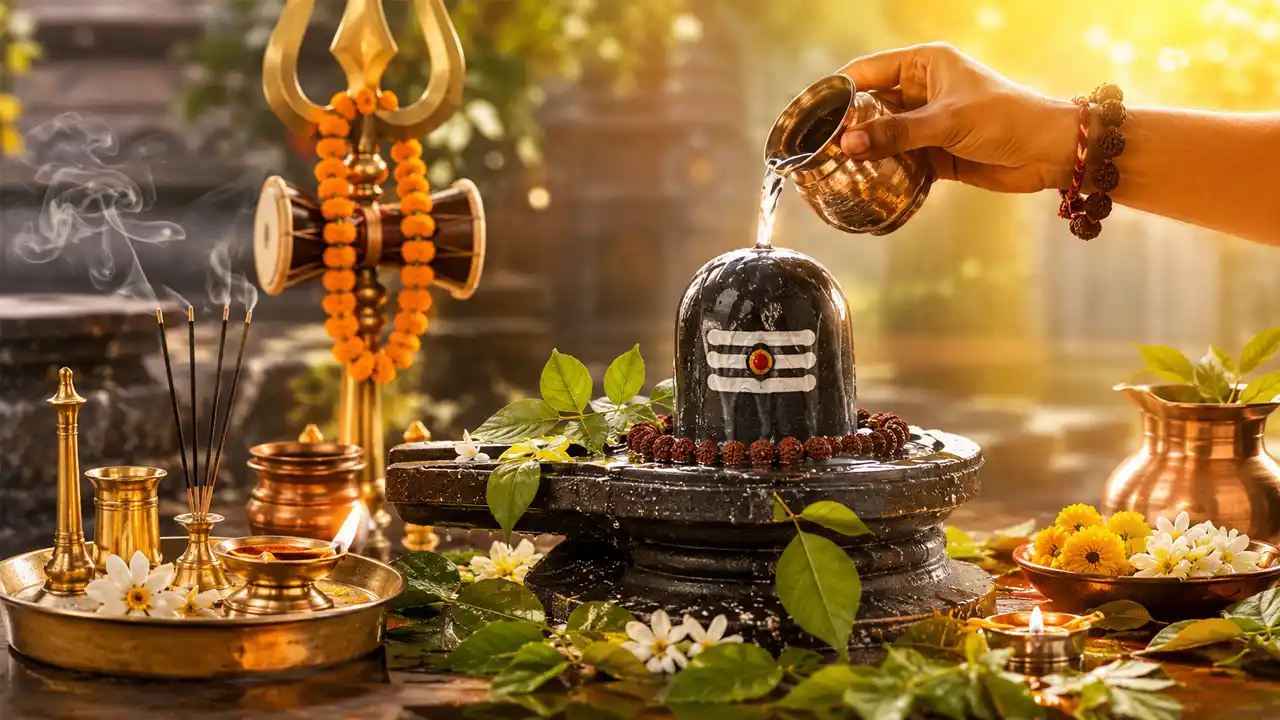
The Sawan of 2026 is the best period of this year to get the blessings from the deva of devas, Mahadeva. Pleasing him in his favorite month is the best time to get rid of all your problems just by performing the right astrological remedies. This guide is the complete destination for your queries like “Sawan Somvar Vrat”, “correct somvar vrat rules”, and “Sawan Puja Vidhi”. Follow the ultimate guidance of “Somvar ko Sawan me Shivling par kya Chadhaye, Jal Abhishek kaise kare”, “Rudrabhishek kaise kare”, and “Sawan Shivratri Puja Vidhi”. This comprehensive guide will help you to resolve all the problems that you are facing in your life by correctly offering your devotion to Mahadeva.
Rudrabhishek is literally "the anointing of Rudra," bathing Shiva in his full glory with holy liquids, while reciting Vedic mantras from Rudrashtadhyayi. This is said to be Shiva's most favored form of worship; it is thought to purify not only the Shivling but the devotee as well.
There are four types, based on scale, of which the simple one, called Laghu Rudrabhishek, is the most commonly performed; there is Ekadash Rudra, Maha Rudra, and Ati Rudra, which include progressively more complex chants. The basic home version is performed with the mantra, Om Namah Shivaya, but a complete Rudrabhishek with the help of a Priest can delve deeper into the experience.
In this Sawan 2026, to get to Shiva, you need to go through Nandi first. The bull is not a decoration, but is an ever-faithful follower of Shiva, his vahana, and is always facing the sanctum, guarding the threshold between the world and the divine. According to tradition, the first step in performing a Shiva puja is to pay reverence to Nandi, placing wishes and prayers into his ears, as it is believed he conveys all the prayers to Shiva. Skip Nandi, and your prayer never leaves the temple.
There is a tradition of worshipping Shiva, and the Shiv Parivar consists of Parvati (strength and grace), Ganesha (obstacles removed), Kartikeya (courage), and Nandi (devotion). Normally, Puja vidhi is done in this sequence: Ganesha first (as remover of obstacles), then Parvati, Kartikeya, Nandi, and then Shiva. In Vedic astrology, it is believed that planets have great importance in deciding our destiny. The Kundli Analysis of you and your family will give you the right path about which planet or lord you must please or pacify in this sawan. It is believed that if the family worships together, there is complete harmony within the family, not only for the members of the family but for the family as a whole.
Offering | What You Receive |
Jal / Gangajal (Water) importance | Calms the mind and fills the heart with compassion |
Dudh Chadhane ka fayda | Blesses the devotee with good health and purity of body |
Curd Chadhane ka fayda | Invites stability, prosperity, and family well-being |
Honey Chadhane ka fayda | Infuses sweetness into speech and relationships |
Bel Patra chadhane ka fayda | Symbolizes the trinity of Brahma, Vishnu, and Shiva; Shiva's most cherished offering, granting purity and devotion |
Misri / Sugar chadhane ka fayda | Boost happiness and brings prosperity into life |
White Flowers, Dhatura & Aak | Traditional offerings symbolizing detachment; believed to please Shiva's ascetic, unconventional nature. |
Bhang chadhane ka fayda | Cleanses the devotee of vices and negative influences |
Panchamrat (Milk, Curd, Ghee, Honey, Sugar) | Offered together as the sacred bathing mixture, granting the fulfillment of desires as a complete, five-fold act of devotion |
Strip away the elaborate rituals, and Jalabhishek remains only water poured with devotion on the Shivling. It is the simplest act of worship in all of Sanatan Dharma and is the one that does not require a priest, Sanskrit language, samagri, etc. It is only the act of devotion that is required.
Take one lota with pure water in it, add some gangajal and a pinch of sugar. Walk to the temple barefoot, reciting “Om Namah Shivay” only in the mind. This is Mansik Japa, the best of all japas. Show respect to every being you encounter in the path. With great devotion, offer the jal to the Shivlinga by saying, “Oh! Lord Shiva, please accept my offering”. Pour the jal on the Shivlinga by reciting the mantra “Om Namah Shivay” only once.
Simplicity is the key. According to tradition, Shiva is happier when the intention is pure than when there is a grand ceremony. The entire formula is one lota of water, one honest heart.
The Moon rules Monday (Somvar), and Shiva is its ultimate master, and he is adorned by the crescent moon on his head. It is believed that the mind is calmed, emotions are brought under control, and Shiva is directly pleased and favours the fasting person on Mondays, as he is said to be most present and most easily pleased on that day. That's why Sawan Somvar Vrat is one of the most widely followed personal fasts of Hindu households throughout the year – not just Sawan.
The fasting in Sawan is not just on Mondays; many devotees follow the whole month with fasting: abstaining from meat, no alcohol, no onion, no garlic, maybe just one sattvic meal per day. This is the idea that the body disciplines itself in accordance with the surrender of the soul. It works with nature on the physical level as well: During the monsoon season, our digestion slows down, and Ayurveda has, for ages, advocated for lighter food during these weeks. Sawan Vrat is the method by which devotion and well-being subtly unite, spiritually and physically.
Shivratri is not a yearly celebration, but it is celebrated on the Krishna Chaturdashi tithi in every month of the year. However, the Shivratri during the month of Sawan has a bigger significance as it falls within the month when it is believed that Shiva is more active on earth.
This is Sawan Shivratri. This is the one night in the Hindu calendar when people don't sleep intentionally, not because they are restless but out of respect. Legend describes the night when Shiva danced the Tandava, the Dance of Creation and Destruction, and set the rhythm of the universe to breathe.
Other versions state that it was the night when Shiva and Parvati were united in marriage, uniting pure consciousness and pure energy. Hence, this month is the best time to consult for marriage compatibility and to perform the suggested remedies for a happy married life.
Then there's another story that's even more gentle: Of a poor hunter named Lubdhaka, who climbed a Bilva tree to escape a tiger and made his way down the night, dropping the leaves of the tree, one by one, onto a hidden Shiva Lingam. His unintentional devotion alone was enough to earn him Shiva's grace, proving that greedless faith, even by mistake that night, becomes worship.
The festival of Sawan Shivratri will be celebrated on August 11, 2026, on the tithi of Krishna Paksha Chaturdashi. In the night, the Nakshatra will transit from Punarvasu to Pushya, which is considered one of the most auspicious Nakshatras in the Vedas and governed by Brihaspati (Guru), symbolizing nourishment, enlightenment, and growth. Nishita Puja Muhurat, when devotees are considered to be worshipping Lord Shiva in the most sacred time, is between 12:05 AM and 12:48 AM. Those following the vrat will be able to break their fast after 5:49 AM on August 12.
Sawan Shivratri Puja Vidhi starts with waking up early in the morning, having a holy bath, and fasting throughout the day. Perform Abhishek to the Shivling with the help of Panchamrit during the Nishita Kaal (evening). Later, offer Gangajal, Bel Patra, Dhatura, white flowers, and chandan to the Shivling. Light a ghee diya and burn some incense sticks while chanting the name of Lord Shiva till the end of Nishita Muhurat. Repeat the "Om Namah Shivaya" mantra 108 times to receive peace, prosperity, and spiritual elevation from Lord Shiva, and then recite the Maha Mrityunjaya Mantra 108 times to get protection and longevity.
Sawan becomes a blessing for you in which you have an opportunity to strengthen your relationship with Lord Shiva through devotion, dedication, and faith. Through the practices mentioned in this guide, from keeping Sawan Somvar Vrat, doing Jal Abhishek and Rudrabhishek to performing Sawan Puja Vidhi and Sawan Shivratri Puja Vidhi, you can seek the blessings of Mahadev in your life in order to enjoy peace, strength, prosperity, and spiritual progress.
Everything you need to know about our astrology consultations, reports, and personalized guidance.
Traditionally, both are allowed. Black stone Shivling (Narmadeshwar) is highly revered as it is a natural Shivling and is believed to be very auspicious for daily worship. The white marble/Sphatik Shivling represents purity and peace. The scriptures stress the observance of worship regularly with devotion to the Shivling rather than its colour.
According to the Shiva Purana, the leaves of Bilva (bel) are more beloved to Lord Shiva than flowers. Among flowers, Dhatura, Aak (Calotropis), white Kaner (Oleander), and white Lotus are offered. Ketaki (Kewda) is banned because of the popular myth in Shiva Purana about false testimony.
Take a bath before dawn and clean the worship area. Set a stone, crystal (Sphatik) or Parad (casket) Shivling. Offer water or Gangajal and then Bilva leaves and white flowers, sandalwood, and incense. Recite the mantra Om Namah Shivaya 108 times, followed by aarti, and meditate for a short while and give prasad. Keep devotion and purity during the worship.
Skanda Purana, Shiva Purana and Vedic tradition say that the worship of Sawan starts with a bath in the morning, wearing clean clothes, and offering Jal or Gangajal to Shivling. Offer Bilva (Bel) leaves with white flowers, Dhatura and sandalwood, recite Om Namah Shivaya or Maha Mrityunjaya Mantra, do aarti, and end with prayers for the welfare of all beings.
According to the teachings of classical texts, purity in the body, words, and mind is recommended. Refrain from eating tamsik food (meat and alcoholic beverages) and be truthful and self-controlled. Do not feed Tulsi leaves, Ketaki flowers, or turmeric to the Shivling. Offer only fresh Bilva leaves and don't allow the Shivling to be touched with unclean hands after eating prohibited food.