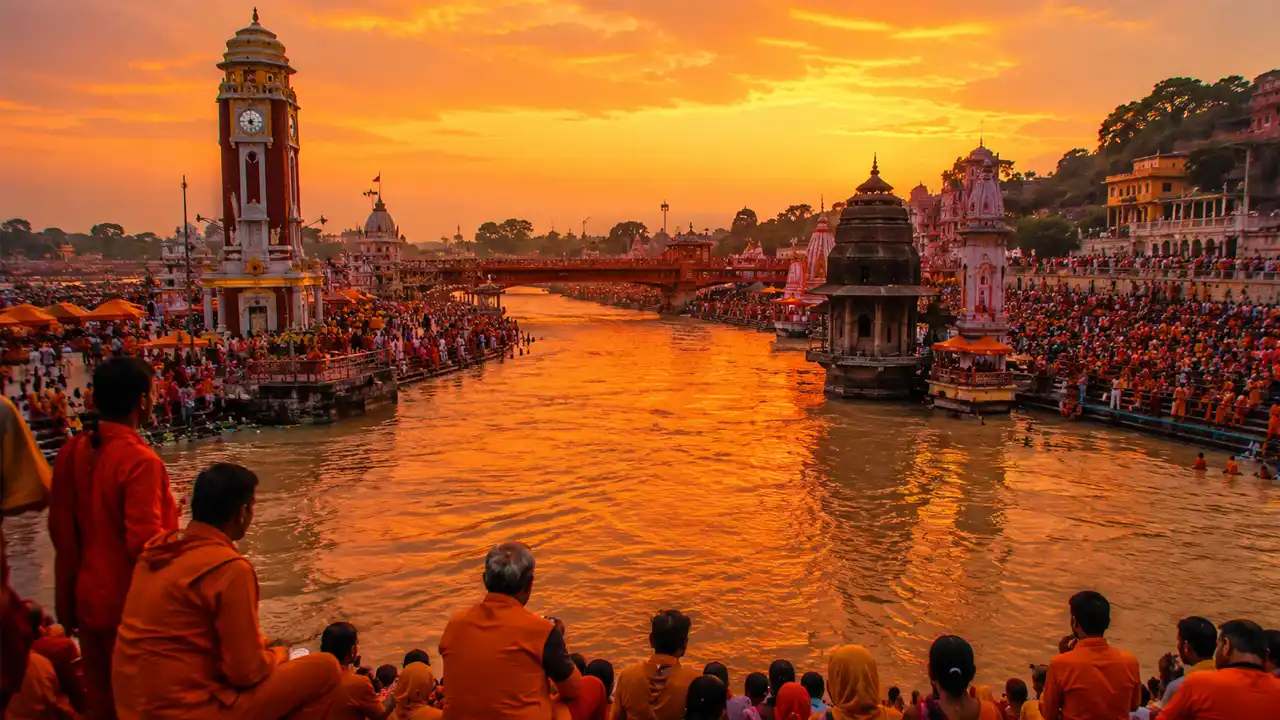
Every Sawan, Haridwar transforms. The ghats of Har Ki Pauri are submerged in saffron as lakhs of Kanwariyas, dressed head to toe in saffron, the color of renunciation, come down to the banks of the Ganga. It's no coincidence that Haridwar is chosen.
The Ganga makes its way to the plains for the first time after coming down from the mountains and is still icy clean. Hindus believe that water from here is the holiest, untouched, unhurried, closest to divinity. It is not a ritualistic aspect of the Kanwari, but rather the whole point of the journey that follows for a Kanwarti, to fill his kanwar with this water.
Himalaya was about to faint when Shiva rode to his own wedding with an army of ghosts, snakes, and spirits. After years of penance, years of fire, years of ice, years of starvation, Parvati had managed to get Shiva's hand. Then, the baraat finally came, and Kailash trumbled with drum and fiery voices, but Mount Himalaya was freezing in fear. There were no silk clothes, no horse, just ash-smudged skin, a garland of skulls around his neck, cobras wrapped as jewelry, and a wild, noisy group of bhoots and pretas behind him dancing and yelling. This barat in Kaliyuga is known as Kanwar Yatra. Guests recoiled, but Parvati didn't blink. She looked beyond the ash to eternity, and she married him to teach the world that true love never flinches at appearances.
It started with one god's suffering and one demon's devotion. Today, it's the largest annual pilgrimage on Earth.
Samudra Manthan churned the ocean of eternity, and it not only released nectar, but it also released Halahala – a poison so powerful that it could have destroyed creation itself. The universe stood in helpless awe as Shiva swallowed it off without a second thought, and it was lodged in his throat. The pain was out of this world. So, the gods did what they could; holy Ganga water was poured over him to quench the fire which no medicine could quench. It was one act of mercy, and it was to become a ritual for eternity.
That was carried forward by Ravana, a fierce, powerful being and worshipper of Shiva, centuries later in the Treta Yuga. He carried water in a bamboo kanwar from Garhmukteshwar and delivered it to Pura Mahadev in Baghpat, travelling long distances. Without realizing it, he became the first Kanwariya, the original pattern of all barefoot pilgrims who would follow him for thousands of years.
The Kanwar Yatra will start from 30 July 2026 and conclude on 11 Aug 2026 on the occasion of Sawan Shivratri. It will be highly auspicious in Vijay Muhurat (2:43 PM to 3:37 PM). The walk of the Kanwar is not a walk. It is a promise, and they will pay a price if they cannot keep it.
One of the most misunderstood aspects of Hinduism is the Shiv Linga. According to scholars and scriptures, it is Nirakar: the formless and infinite energy of Shiva, not an actual image of a physical thing that the human mind can meditate on.
The word "Linga" means "sign" or "mark," which is a mark of the origin point of the universe, where the unmanifest becomes manifest. It is traditionally used with the Yoni base to represent union, the union of Shiva (consciousness) and Shakti (energy), and is thought to be the partner of the former. Worshipping the Linga is worshipping the essence of existence, bereft of shape and form.
According to legend, Rudraksha beads were created from the tears of Shiva, which fell to the ground and turned into the seeds of protection. Each bead is categorized according to the number of natural facial lines (known as mukhi), and each mukhi has its own ruling deity, planet, and purpose.
Mukhi | Name | Ruling Planet | Ruling Deity | Significance |
The Rudraksha of Shiva Himself | Sun | Lord Shiva | The rarest and most supreme of all Rudrakshas. Wearers are believed to grow fearless, deeply spiritual, and detached from worldly anxiety while still enjoying health, wealth, and contentment. | |
The Unity Bead | Moon | Shiva-Parvati (united form) | Symbolizes the union of Shiva and Parvati. Worn to harmonize relationships between spouses, parents and children, or close friends, bringing reconciliation where there was distance. | |
The Fire of Purification | Mars | Agni | Said to burn away guilt and past-life karma. Recommended for those battling self-doubt, inferiority, or unexplained fear. | |
The Bead of Knowledge | Mercury | Brahma | Sharpens memory, concentration, and speech. A favorite among students and anyone whose work depends on clear communication. | |
The Everyday Rudraksha | Jupiter | Kalagni Rudra | The most commonly worn bead, known as the "Dev Guru Rudraksha." Calms the mind, dissolves everyday bad karma, and is ideal for daily wear and meditation. | |
The Bead of Willpower | Venus | Kartikeya | Strengthens willpower and expression. Well suited to leaders, speakers, and performers who need presence and courage. | |
The Bead of Wealth | Saturn | Mahalakshmi & Saptarshi | Worn for prosperity and to ease the effects of a difficult Saturn (Sade Sati) in one's chart. A common choice for business owners and professionals. | |
8 Mukhi | The Obstacle Remover | Rahu | Ganesha | Worn for stability of mind and steady success in ventures that keep hitting roadblocks. |
9 Mukhi | The Fearless Bead | Ketu | Navdurga & Kaal Bhairav | Home to all nine forms of Goddess Durga, blessed by Kaal Bhairav. Worn for courage, protection, and freedom from fear, even the fear of death. |
Beginners are usually guided toward the 5 Mukhi - gentle, balanced, safe for daily wear before moving to a specific mukhi aligned with a personal goal, ideally under proper guidance.
“It's just five syllables. Yet sages say it can dissolve karma accumulated over lifetimes.”
The real Panchakshari mantra consists of five syllables (Na, Mah, Shi, Vā, Ya) without the Om. They are all the five elements that create the universe: earth, water, fire, air and space.
We say "Om" before it, why? Because chanting is by humans and humans make mistakes – a mispronunciation, a mis-rhythm, a wandering mind. Om, the primordial vibration of existence, is used as a correcting 'seal' to incorporate these inadvertent errors and provide the mantra with the presence of Shiva.
The meaning remains simple: "Namam" means "surrender of the ego", "Shivaya" means "devotion to Shiva". Five words. Complete surrender. But that alone, according to tradition, is a ritual that can begin to dissolve the karmas.
The Orange Color at Har Ki Pauri during Sawan comes not due to any festival, but millions opt for devotion instead of comfort. The saffron-robed Kanwariyas, the holy waters of Ganga, the invocation of Bol Bam - Bam Bam, the rudraksha mala tied around the neck, the Panchakshari Jap Mantra all are indicators of only one eternal reality that the path to Shiva starts much before the Shivlinga. It begins with self-discipline, surrender, and faith. Whether one decides to take the path of Kanwar Yatra or just offers a pot of Ganga water, Sawan teaches us that the greatest of pilgrimages start from within us.
Everything you need to know about our astrology consultations, reports, and personalized guidance.
The majority of Kanwariyas from Delhi/NCR reach the holy city of Haridwar via Ghaziabad, Modinagar, Meerut, Muzaffarnagar, Roorkee and Haridwar to pick up the Ganga Jal. They fill their Kanwars at Har Ki Pauri, and then walk along the Kanwar path, bringing the water to the Shiva temples in Delhi, Noida, Gurugram, Faridabad and other nearby areas.
According to the Kanwar Yatra 2026 date, the Kanwar Yatra is expected to start from the beginning of the Sawan month on 30 July 2026 (Thursday). The devotees take water from Haridwar, Rishikesh, Gangotri, and Gaumukh and bring it to the Shiva temples to do Jalabhishek. The major event of the pilgrimage is on Sawan Shivratri on 11 August 2026.
Sawan Shivratri is on Tuesday, 11 August 2026. It is one of the most sacred days of the Shravan month, and millions of Kanwariyas make the pilgrimage and pour Ganga Jal onto the Shivling. Fasting is observed, night-long worship is conducted, and Om Namah Shivaya is chanted throughout the day and night.
Mahashivratri is celebrated during Phalguna month, paying homage to Lord Shiva's divine marriage with Goddess Parvati and his cosmic form. Sawan Shivratri is observed in the month of Shravan and is all about Jalabhishek and deep devotion towards Shiva. Both are auspicious, but Sawan Shivratri is particularly related to Kanwar Yatra and Ganga water.
Traditional literature and traditional practices associated with Kanwar Yatra broadly divide it into four categories, which are: Samanya Kanwar, Kanwar walked at the pace of the devotees; Dak Kanwar, Kanwar walked without stopping; Khadi Kanwar, in which devotees do not sit down to place their Kanwar; and Dandi Kanwar, in which devotees prostrate themselves or undertake extreme penance throughout the walk.